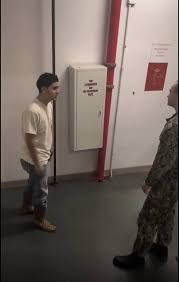
It was supposed to be an ordinary moment, the kind of situation most people would never expect to become a serious confrontation. But in a matter of seconds, everything changed when one man apparently decided to take a cheap shot at a U.S. Navy sailor.
The encounter quickly became a lesson in why underestimating someone can be a very bad idea.
According to the story circulating online, the sailor found himself facing an aggressive individual who appeared to be looking for trouble. Rather than confronting him openly, the man allegedly attempted a sucker punch—a sudden strike designed to catch the sailor off guard.
But the plan did not go as expected.
The sailor reacted quickly, and what was supposed to be a surprise attack suddenly turned into a completely different situation.
A sucker punch depends on one major advantage: surprise. The attacker expects the other person to be distracted, unaware, or too slow to react. But when that advantage disappears, the attacker can suddenly find himself in a situation he never anticipated.
That appears to be exactly what happened.
The sailor recognized the threat and responded before the situation could escalate further. Instead of standing frozen or allowing the attacker to continue, he defended himself and gained control of the confrontation.
For the person who started the trouble, the outcome was clearly not what he had imagined.
The incident is a reminder that confidence and aggression are not the same thing as strength. Someone may believe they can intimidate another person, but the reality can be very different once their target refuses to be intimidated.
Military personnel, including sailors in the U.S. Navy, receive extensive training and are accustomed to staying alert under pressure. That does not mean every sailor is looking for a fight. In fact, military training often emphasizes discipline, awareness, and controlling a situation rather than recklessly escalating it.
But when someone suddenly attacks, the ability to react calmly can make a major difference.
The attempted sucker punch also raises an important question: Why would anyone attack a stranger without knowing how that person might respond?
People often make dangerous assumptions. They may judge someone by appearance, clothing, age, or body size. They may believe a person will simply back down. They may think they can land one quick punch and walk away before anything happens.

Those assumptions can have serious consequences.
In this case, the attacker apparently believed he had the advantage. He initiated the confrontation and attempted to strike first. But the sailor’s reaction changed the entire balance of the situation.
What happened next reportedly left the aggressor regretting his decision.
The most important lesson is not that fighting is the answer. It is that unnecessary aggression can turn an ordinary situation into a dangerous one almost instantly.
A person who chooses violence has no guarantee that the other person will react the way they expect.
There is also a difference between defending yourself and looking for a fight. A person who is attacked may have to protect themselves, but the safest option whenever possible is to create distance, seek help, and avoid escalating the confrontation.
That principle is especially important in public places, where one unexpected punch can cause far more damage than anyone intended.
A fall onto concrete, a head injury, or a chain reaction involving other people can turn a brief confrontation into a medical emergency or criminal investigation.
That is why incidents like this should never be treated simply as entertainment.
Still, the story has attracted attention because of the dramatic contrast between the attacker’s apparent confidence and the outcome. The person who tried to catch the sailor off guard apparently discovered that his target was not an easy victim.
The phrase “big mistake” fits the situation perfectly.
The attacker thought he had found an opportunity.
Instead, he may have found someone who was prepared to defend himself.
The incident also highlights the importance of situational awareness. People do not always announce their intentions before becoming aggressive. A sudden movement, hostile body language, shouting, or someone rapidly closing distance can sometimes signal that a confrontation is about to happen.
Being aware of your surroundings can provide valuable seconds to react.
Those seconds can matter.
For military personnel, awareness is part of professional training. Service members routinely operate in environments where they must pay attention to what is happening around them. They learn to remain composed when situations become stressful.
That composure can be useful far beyond the military environment.
When someone is suddenly attacked, panic can make it harder to think clearly. A trained or experienced person may be more capable of recognizing what is happening and responding quickly.
That does not make anyone invincible.
Even highly trained people can be injured in unexpected confrontations. A surprise attack can be dangerous for anyone, regardless of their occupation.
That is another reason why starting a physical confrontation is such a reckless decision.
The attacker cannot know whether the person he targets has military experience, martial arts training, friends nearby, or simply the determination to protect himself.
He also cannot know whether witnesses will call the police or whether cameras are recording the incident.
Modern public spaces are filled with surveillance cameras and smartphones. A confrontation that lasts only a few seconds can potentially be recorded from several different angles.
That evidence can become extremely important when authorities investigate what happened.
For the sailor involved, the encounter may have been nothing more than an unexpected attempt at intimidation that quickly ended. But for the person who initiated the confrontation, the consequences could potentially last much longer.
There is a broader lesson here about respect.
People do not have to agree with each other. They may argue, misunderstand one another, or have completely different personalities. But there is a line between disagreement and physical violence.
Crossing that line can change everything.
A verbal argument can end with both people walking away.