US expects to have ‘complete and total dominance’ over Iranian airspace, Leavitt says
5 minutes ago
10:29 PST


Michelle Nichols and David Ljunggren
White House press secretary Karoline Leavitt repeated a claim that the U.S. will have “complete and total dominance” over Iranian airspace soon.
“As the Department of War said this morning, we expect to have complete and total dominance over Iranian airspace in the coming hours, clearing the skies for our brave warriors to continue achieving these noble and long-sought-after objectives.”
She added that “the world knows this president’s preference is always peace and diplomacy first.”
“They accepted none of these generous and unprecedented offers by the United States,” Leavitt said, referring to Iran.
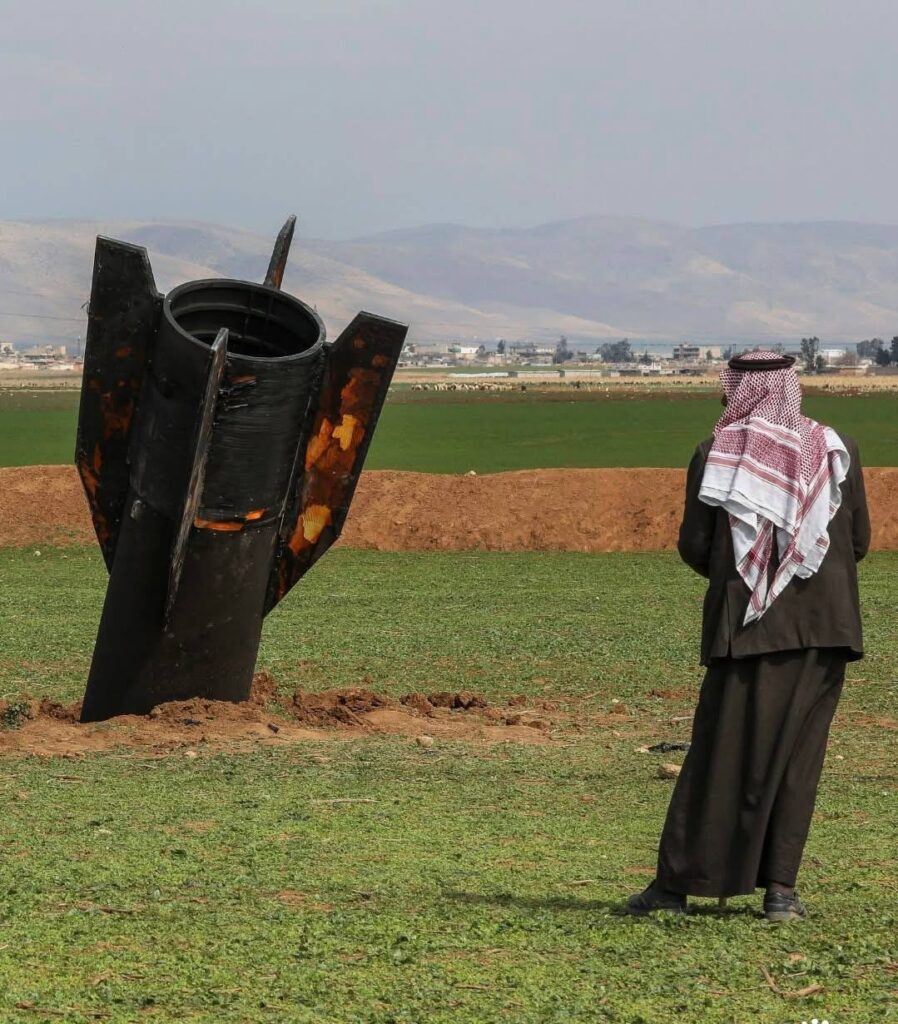
eople gathered around a missile that fell in an open space near the Kurdish-controlled city of Qamishli in northeastern Syria. No injuries were reported.
Reuters could not independently verify the source of the missile.
Wall Street indexes rose as investors weighed a report that Iranian operatives secretively reached out to the U.S. to pursue talks to end the conflict.
Trump’s announcements of a U.S. naval escort for oil tankers through the Strait of Hormuz and political risk insurance also brought some relief.
The New York Times reported that Iranian intelligence operatives indirectly reached out to the CIA a day after the attacks, but U.S. officials remain skeptical that either the Trump administration or Iran were prepared for a near-term de-escalation.
Despite the report there is always the possibility of further escalation, Chris Zaccarelli, chief investment officer for Northlight Asset Management, said, adding that U.S. investors have been relatively resilient since the war started.
“Until people think what’s happening in the Middle East will cause a recession, they’re giving stocks the benefit of the doubt.”
The U.S. military on Friday asked mining companies to help boost domestic supplies of 13 critical minerals used to make semiconductors, weapons and other products, a document reviewed by Reuters showed.
The request came one day before the U.S. and Israel launched strikes on Iran and is the latest evidence of Washington’s weak access to materials used widely in warfare.
The Pentagon asked members of the Defense Industrial Base Consortium (DIBC), a group of companies, universities and others that supply the military, for proposals to be submitted by March 20 for projects that could mine, process or recycle nickel, graphite, rare earths and other minerals, the document showed.
The White House, DIBC and Pentagon did not immediately respond to requests for comment.
A video appearing to show the sinking of an Iranian warship was released by the United States Department of Defense on Wednesday.
The exact date the video was filmed and the type of warship could not be verified.
However, U.S. Defense Secretary Pete Hegseth confirmed a U.S. submarine sank an Iranian warship of the southern coast of Sri Lanka on Wednesday.
Sri Lankan Foreign Minister Vijitha Herath identified the Iranian vessel as the IRIS Dena.
Oil prices were steady despite volatile trading.
Brent crude was down 24 cents, or 0.3%, to $81.13 per barrel at 11:18 a.m. ET (1618 GMT).
On Tuesday, Brent closed at its highest since January 2025.
U.S. West Texas Intermediate crude was down 27 cents, or 0.4%, to $74.30, a day after settling at its highest since June.
“While flows through the Strait of Hormuz remain disrupted, market participants seem to expect a de-escalation of the conflict and a resumption of oil flows,” UBS analyst Giovanni Staunovo said.
“The market should, however, also focus on the risk of further production shut-ins if flows through the Strait remain disrupted, in my view.”