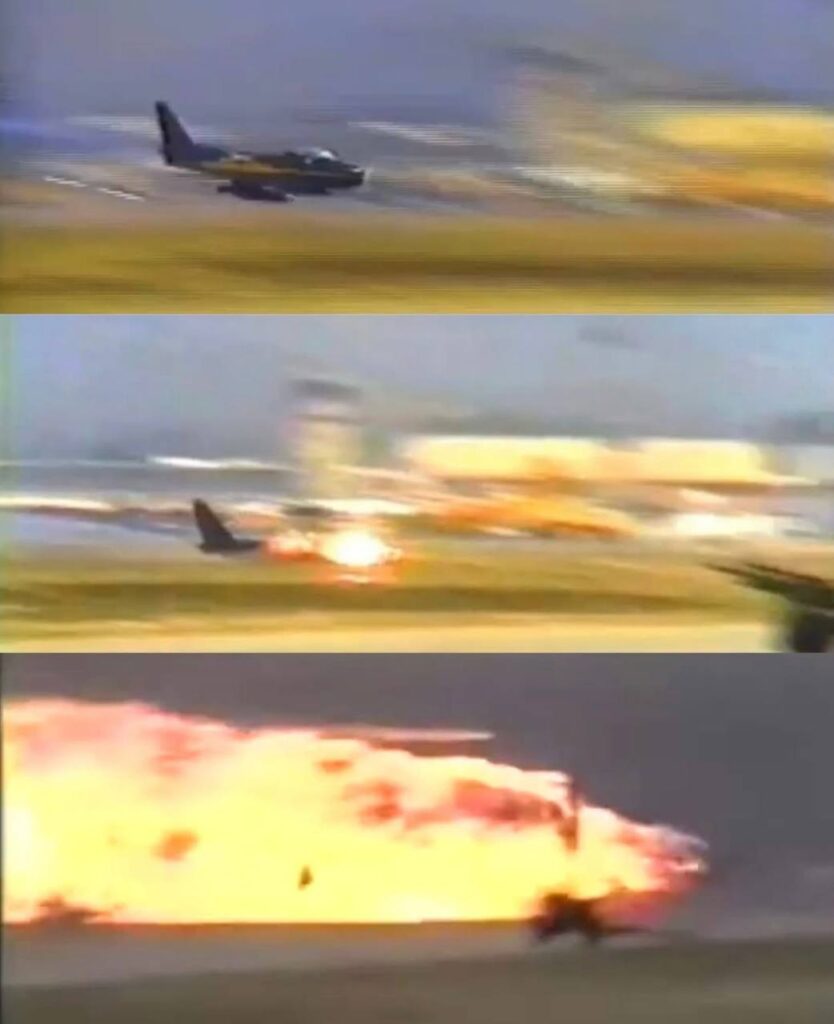
On Sunday, May 2, 1993, at 14:43, the skies over Santa Ana, California, United States witnessed a tragic aviation accident that would later be studied for its lessons in human judgment and aerodynamic limits.
A privately owned Canadair F-86E Sabre Mk 6 (Registration: N3842J) took off from Marine Corps Air Station El Toro (KNZJ) with a planned airshow routine originally designed to include a MiG-15 formation partner. When the second aircraft was unable to participate, the pilot made a spontaneous decision—to perform a solo aerobatic routine that had not been fully rehearsed for the display.
What began as controlled excitement quickly shifted into something far more dangerous.
Shortly after takeoff, the Sabre entered a loop, climbing into the sky before rolling at the top of the maneuver. For a brief moment, the aircraft hung inverted—suspended between precision and risk. But the descent from the maneuver became unstable. Instead of a smooth recovery, the aircraft developed a dangerously high rate of descent, closing rapidly toward the runway below.
At this critical moment, physics took over. The aircraft and pilot were subjected to an estimated 6.4 Gs during the pull-out attempt—an extreme force that severely strains the human body. Compounding the situation, the pilot was not wearing a G-suit, reducing his tolerance to sustained gravitational stress. In those final seconds, spatial awareness and physical capacity were pushed beyond their limits.
The Sabre struck the runway in a near nose-and-wing-level attitude. The aircraft was destroyed. The pilot, the sole occupant, was killed. Remarkably, no spectators were injured.
Investigators from the National Transportation Safety Board (NTSB) later concluded that the accident was not caused by mechanical failure, but by a chain of human decisions: inadequate planning for the maneuver, insufficient altitude for safe recovery, and physiological limitations under high G-forces without proper equipment.
This accident, occurring on that quiet afternoon in Santa Ana, stands as a powerful reminder that in aviation, even experienced hands are bound by unforgiving laws—where improvisation, altitude misjudgment, and human limits can converge in a matter of seconds, leaving no room for correction.